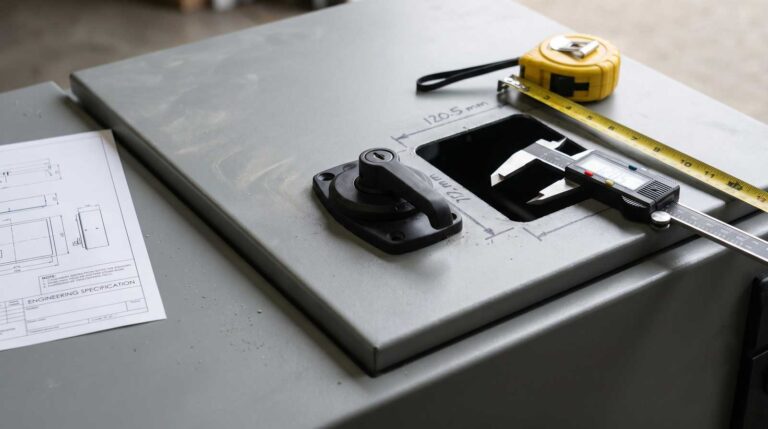


Introduction
Material selection for compression latches is one of the most consequential decisions in enclosure hardware specification — and one of the most commonly gotten wrong. Specify zinc alloy for a marine environment and the latch will corrode within 18 months. Specify SS316 for every indoor control panel and your BOM cost increases unnecessarily.
This guide provides practical, data-backed guidance on which material to use for which application.
Material Comparison Table
| Property | Zinc Alloy | SS304 | SS316 |
| Salt Spray (ASTM B117) | 96–500 hours | 720+ hours | 1,000+ hours |
| Typical IP Rating | IP54–IP65 | IP65–IP66 | IP65–IP67 |
| Relative Cost | $ (baseline) | $$ (1.5–2×) | $$$ (2–3×) |
| Best For | Indoor enclosures | Outdoor (temperate) | Marine/Offshore/Chemical |
| Corrosion Mechanism | White rust → structural | Surface pitting (slow) | Minimal in most environments |
Zinc Alloy: When It’s the Right Choice
Zinc alloy is not a “budget option” — it’s the optimal material for most indoor industrial applications. A zinc alloy compression latch with zinc plating or powder coating will perform reliably for 10+ years in a climate-controlled factory environment.
Use zinc alloy when:
- Indoor control panels, distribution cabinets, HVAC panels
- Non-corrosive environments
- Budget sensitivity without sacrificing function
SS304: The Workhorse for Outdoor Applications
SS304 (also called 18/8 stainless) is the most versatile material in the compression latch range. It provides excellent corrosion resistance for outdoor applications in temperate, non-coastal environments.
Use SS304 when:
- Outdoor enclosures away from saltwater
- UV-exposed installations (no coating degradation)
- Moderate chemical exposure (industrial atmospheres)
- Clean environments where surface rust is unacceptable
SS316: Marine-Grade as Standard
SS316 adds 2–3% molybdenum to the SS304 composition — and that small addition makes a critical difference in chloride-rich environments. SS316 is the standard material for any application within 5 km of saltwater, any offshore installation, and any food/chemical processing environment.
At SecuriLock, SS316 is the baseline for our marine compression latch range — not an upgrade from zinc.
Use SS316 when:
- Marine vessels, offshore platforms, coastal installations
- Food processing (daily CIP washdown)
- Chemical processing environments
- Anywhere salt spray resistance above 720 hours is required
Application Decision Matrix
| Environment | Recommended Material | Finish |
| Indoor control panel | Zinc alloy | Zinc plated |
| Outdoor enclosure (temperate) | Zinc alloy | Powder coated UV-stable |
| Outdoor enclosure (coastal) | SS304 | Passivated |
| Marine vessel / Offshore | SS316 | Electropolished |
| Food processing (washdown) | SS316 | Mirror polish |
| Chemical processing | SS316 | Electropolished |
The Cost of Getting It Wrong
| Wrong Specification | Failure Timeline | Consequence |
| Zinc in marine environment | 12–18 months | Latch seizure, IP seal loss |
| Zinc in outdoor (uncoated) | 24–36 months | White rust, aesthetic failure |
| SS304 in offshore | 2–5 years | Surface pitting, eventual seal compromise |
| SS316 for indoor control panel | Never fails | Unnecessary cost (2–3× zinc) |
Key Takeaway
Match the material to the environment — not the budget. A zinc alloy latch that fails in 18 months costs far more in warranty claims and field replacements than an SS316 latch specified correctly from the start.