Last updated:
What Is a Rotary Latch? Working Principle, Types and Applications
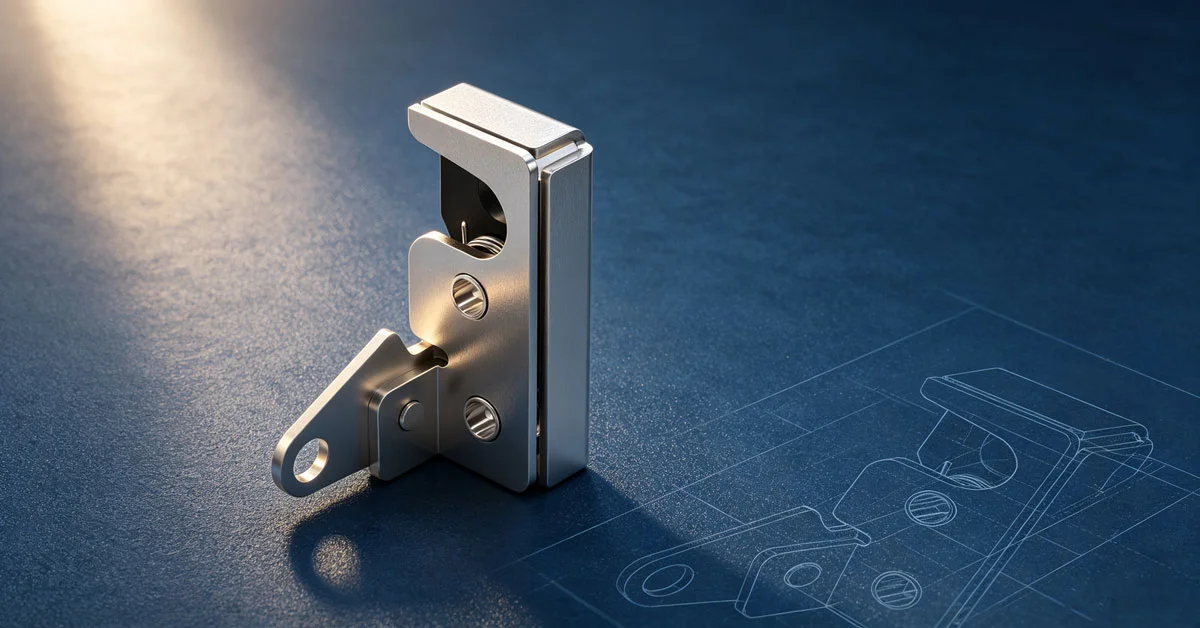
A rotary latch is a mechanical latching device that secures a door, hatch or panel by rotating a cam-shaped rotor around a fixed striker. As the door closes, the striker enters the latch mouth, pushes the rotor through its rotation, and is captured inside the rotor jaw. The door is then held firmly against its frame and seal until a handle, button or cable rotates the rotor back and releases the striker.
This working principle is fundamentally different from a conventional sliding-bolt or slam latch. A bolt latch pushes a straight bolt into a keep and depends on a spring to hold it there; under sustained vibration the bolt can fret, wear or even walk back out of engagement. A rotary latch instead clamps the striker inside a rotating jaw, so the harder the door pulls, the more securely the striker is trapped. That is why rotary latches have become the standard door hardware on off-highway machinery, industrial enclosures and specialty vehicles. This guide covers the working principle, the main types, common actuation methods, typical applications and the five factors that matter most when selecting a rotary latch.
What Is a Rotary Latch?
In one sentence: a rotary latch is a slam-shut, rotary-jaw latch that captures a striker pin or bar and locks it in place until deliberately released. You push the door closed — the latch does the rest.
Compared with an ordinary bolt latch, three differences stand out:
- Positive capture. The striker is enclosed by the rotor jaw rather than resting against the end of a bolt, so the door cannot shake itself open.
- Slam-to-close convenience. No handle operation is needed to close the door; the striker trips the rotor automatically.
- Wear compensation. The rotating jaw and spring-loaded pawl tolerate striker wear, seal compression set and minor door sag far better than a bolt-and-keep alignment.
How Does a Rotary Latch Work?
Rotor and Striker Engagement
The mechanism has two core parts: the rotor, a cam-profiled steel jaw inside the latch housing, and the striker, a pin, bolt or bent bar mounted on the opposite door half. Closing happens in three stages:
- The striker enters the latch mouth and contacts the open rotor.
- Door momentum rotates the rotor past a trip point; a spring-loaded pawl drops in behind it.
- The rotor jaw closes around the striker and clamps it against a rubber bumper, pulling the door tight to its seal.
To open the door, a release lever or cable lifts the pawl. A return spring snaps the rotor back to the open position and ejects the striker, so the door pops free of its seal with modest effort.
Single-Rotor and Twin-Rotor Designs
A single-rotor latch uses one rotating jaw. It is compact and economical, and suits light to medium doors, cabinets and access panels. A twin-rotor (double-rotor) latch uses two opposed rotors that close around the striker from both sides. The clamping load is shared between two jaws, which gives higher load capacity and better resistance to the racking forces of large, heavy or flexing doors — the typical choice for off-highway cab doors and other demanding closures.
Primary and Secondary Latch Positions
Quality rotary latches provide two-stage latching. The primary position is the fully closed state: the rotor has completed its travel and the door seal is compressed. The secondary (safety) position is an intermediate catch: if the door is not slammed fully home, the rotor still traps the striker partway through its rotation. The door may sit slightly proud of the seal, but it cannot fly open. On moving vehicles this is a critical safety function, and it is one of the first features to verify when comparing latches.
Common Actuation Methods
The latch itself is only half of the system; the other half is how the operator releases it. Five actuation layouts cover most applications:
- Top drive – the release mechanism acts on the top of the latch, common where the handle sits above the latch line.
- Bottom drive – release from below, suited to low-mounted latches and linkage from sill-level handles.
- Direct drive – the handle or release lever connects straight into the latch with minimal linkage, reducing play and adjustment.
- Manual drive – an integrated lever or push-button on the latch body, for panels and cabinets without separate handles.
- Remote cable or rod drive – the latch sits deep in the door while Bowden cables or rods connect it to interior and exterior handles, locks and inside safety releases.
Each layout has its own installation rules and failure modes; we cover them in dedicated guides linked from our product pages.
Typical Applications
Construction and agricultural machinery. Excavator, loader, tractor and harvester cab doors are the classic rotary latch application: heavy doors, slam closing with gloved hands, severe vibration and dust, and a legal expectation that the door cannot open unintentionally.
Industrial cabinets and enclosures. Generator canopies, compressor housings and electrical enclosures use compact rotary latches to hold large access doors tight against acoustic and weather seals.
RV and specialty vehicles. Motorhome entry doors, ambulance and fire-truck compartments, and service-body doors rely on two-stage rotary latches for the same reason passenger cars do: secure slam closing with a safety catch.
Rail and mass transit. Interior equipment lockers, gangway access panels and exterior service hatches use rotary latches selected for vibration endurance and corrosion protection.
Five Factors for Selecting a Rotary Latch
- Door weight and size. Heavy or tall doors need twin-rotor designs and robust strikers; always match the latch class to the door mass and the bending moment of an open door.
- Vibration environment. On-engine or off-highway mounting demands positive pawl engagement, anti-rattle bumpers and fasteners with thread locking. A latch that is quiet on a bench can chatter on a machine.
- Sealing pressure. The latch must overcome and then hold the compression load of the door seal. Thick acoustic or IP-rated seals significantly increase closing force — check both the slam effort and the clamping margin.
- Installation space. Confirm housing depth inside the door, striker adjustment range, and the routing space for cables or rods before committing to a drive layout.
- Operation method. Define who opens the door, from where, wearing what. Gloved operators, interior safety releases and remote handles all point to different actuation choices.
| Selection factor | What to verify | Typical risk if ignored |
|---|---|---|
| Door weight and size | Latch class, rotor count, striker strength | Door sag, latch wear, failed closing |
| Vibration | Pawl engagement, bumpers, fastener locking | Rattle, self-opening, fatigue cracks |
| Sealing pressure | Closing effort and clamping margin | Door will not latch or leaks |
| Installation space | Housing depth, cable routing, adjustment | Costly door redesign late in the project |
| Operation method | Handles, releases, ergonomics | Poor usability, unsafe exit paths |
Materials and Environmental Protection
Most industrial rotary latches use zinc-plated or e-coated steel housings and rotors; for outdoor, coastal or wash-down service, stainless steel components and sealed housings are worth the premium. Where dust and water ingress matter, look for latch designs tested to defined IP ratings, and pair the latch with a striker that allows vertical and lateral adjustment so the door seal can be tuned during assembly. Rubber or elastomer bumpers are not a detail: they set the closing sound, absorb vibration energy and protect the coating on the striker.
The SecuriLock Rotary Latch Product Line
SecuriLock manufactures a focused range of rotary latches for industrial doors. The range covers vertical drive rotary locks for handle-above-latch layouts, extended vertical drive versions for tall door geometry, top drive, bottom drive and direct drive variants, and manual drive rotary latches with integrated release for cabinets and access panels. A heavy-duty damped manual version is available for closures where controlled, quiet release matters. You can browse the full range on our industrial latch product page.
Because we are a B2B manufacturer, every product line can be adapted to your door design — striker geometry, drive direction, finish and mounting interface can all be customized under OEM agreements. If you do not see the exact configuration you need, our engineers will respond to your inquiry within 24 hours.
Conclusion
A rotary latch secures a door by rotating a jaw around a striker — a simple principle that delivers slam-shut convenience, two-stage safety and vibration-proof retention. Match the rotor design, actuation method and materials to your door weight, sealing load and operating environment, and the latch will outlast the machine around it.
Need help sizing a rotary latch for your application? Contact the SecuriLock engineering team — we answer every inquiry within 24 hours.